

In your chapter on nettle, you say that cooking nettle keeps it from stinging. Why is this?
Dr. J. P., Salt Lake
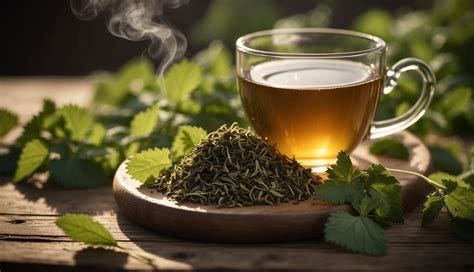
Nettle tea has no caffeine, and won’t sting you, either.
Great question. And shame on me for not addressing it in my book, Herbs Demystified. Since I can't find a readily available scientific explanation right off the bat, I will give you my best guess.
The simplest explanation is that heat causes nettle’s stingers to poop out their inflammatory contents, which then get diluted by the rest of the cooked material. Heat causes molecules to move faster, increasing pressure, and you can imagine that boiling causes nettle stinger cell contents to pop like tiny, over-pressurized balloons.
Since the inflammatory molecules are now are dilute, they are less potent. Realize that a nettle stinger injects a small area of your skin with a concentrated dose of inflammatory mediators.
Sometimes heating molecules causes them to degrade, that is, to change into other molecules which don't have the same activity. But I suspect that is not going on with these molecules. Some molecules are more fragile than others.
Also, heating molecules sometimes gives them enough energy to leave the pot, so to speak, and fly around the room. That’s evaporation. If the molecule has a smell, you can detect such escapism when the molecule flies up your nose. But these are not very volatile (easy to evaporate) molecules, so I don't think that is the case, either. These molecules are too attracted to water to want to leave the pot.
When heated, the stingers themselves are likely to denature (the formal term for a biomolecule losing its shape), so the mixture will no longer contain mini-injectors, as well.
I hope that helps!
Holly